
 |
 |
 |
 |
 |
 |
 |
 |
 Focus
Focus
This CEPII Working Paper develops a quantitative model of trade and conflicts and apply it to the US-China relationship. The authors argue that all welfare-relevant geoeconomic factors, such as the realized costs of war, the concessions to prevent it, and the probability of escalation, depend on the opportunity cost of war, itself shaped by observed trade flows. The growing US dependence to Chinese products over the past thirty years has increased the cost of geopolitical disputes with China for the US. While decoupling from China could offer geopolitical benefits, the paper highlights a fundamental security dilemma: decoupling can paradoxically raise the risk of escalation by weakening incentives for restraint. Thierry Mayer, Isabelle Méjean, Mathias Thoenig
>>> |
.jpg)
MIRAGE is a multi-sector, multi-region computable general equilibrium model designed by the CEPII for economic policy analysis, particularly focusing on trade and environmental policies. The model features advanced trade modeling capabilities with detailed treatment of trade costs, Armington specifications, and analysis of trade barriers through the MAcMap-HS6 database. Enhanced energy sector representation includes detailed electricity generation modeling with renewable energy integration considering base-load and peak-load, capital-energy bundles, and greenhouse gas emissions accounting with carbon market mechanisms. The sequential dynamic framework enables long-term economic projections by combining total factor productivity calibration with macroeconomic forecasts from the MaGE model for consistent policy scenario analysis. Antoine Bouët, Lionel Fontagné, Christophe Gouel, Houssein Guimbard, Cristina Mitaritonna, Balthazar de Vaulchier, Yu Zheng
>>> |
 publications

- Conceptualizing Violence in Space as a Flow
Mathieu Couttenier, Julian Marcoux, Thierry Mayer, Mathias Thoening - Share of Immigrants in France: A Level and an Increase Lower Than in the Main European Host Countries
Anthony Edo, Jérôme Valette

- MIRAGE Model Documentation Version 2.0
Antoine Bouët, Lionel Fontagné, Christophe Gouel, Houssein Guimbard, Cristina Mitaritonna, Balthazar de Vaulchier, Yu Zheng - The Fragmentation Paradox: De-risking Trade and Global Safety
Thierry Mayer, Isabelle Méjean, Mathias Thoenig - Monetary Policy and Life Insurance Profitability: Bancassurance’s Edge in a Low-Yield World
Pablo Aguilar-Perez - Global Spillovers of US Monetary Policy: New Insights from the Remittance Channel
Pablo Aguilar-Perez - The Impact of the Far Right on Mainstream Politics: Evidence from the Front National
Anthony Edo, Thomas Renault, Jérôme Valette - Immigration, Identity Choices, and Cultural Diversity
Yasmine Elkhateeb, Riccardo Turati, Jérôme Valette - Sectoral Linkages and the Impact of Immigration on Export Performance
Amandine Aubry, Anthony Edo

- Labour Economics
Does Immigration Affect Native Wages? A Meta-Analysis
Amandine Aubry, Jérôme Héricourt, Léa Marchal, Clément Nedoncelle - Ecological Economics
Outsourcing decarbonization? How trade shaped France’s carbon footprint (2000–14)
Pierre Cotterlaz, Christophe Gouel - Journal of Development Economics
Firms under fire! How insecurity affects formal firms’ existence
Matteo Neri-Lainé
 Facts & Figures
 >>> |
Conceptualizing Violence in Space as a Flow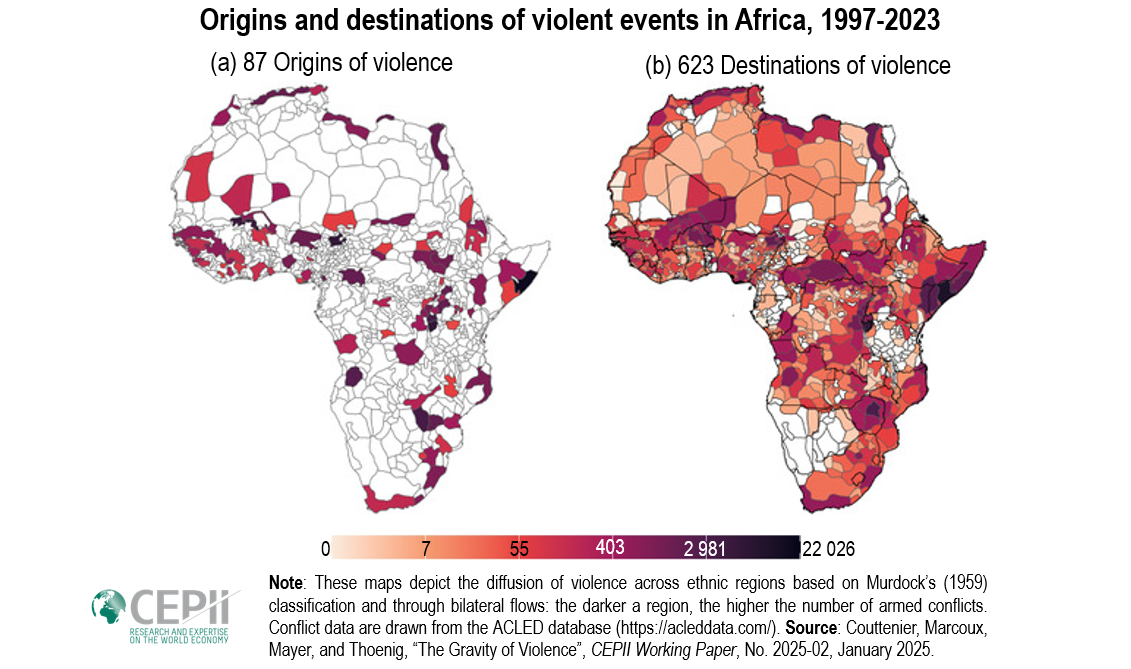 Many analyses of armed conflicts fail to take into account the spatial origins of combatant groups, as well as the competition among them on predation markets that underlies the diffusion of violence. Mathieu Couttenier, Julian Marcoux, Thierry Mayer, Mathias Thoening >>> |
Share of Immigrants in France: A Level and an Increase Lower Than in the Main European Host Countries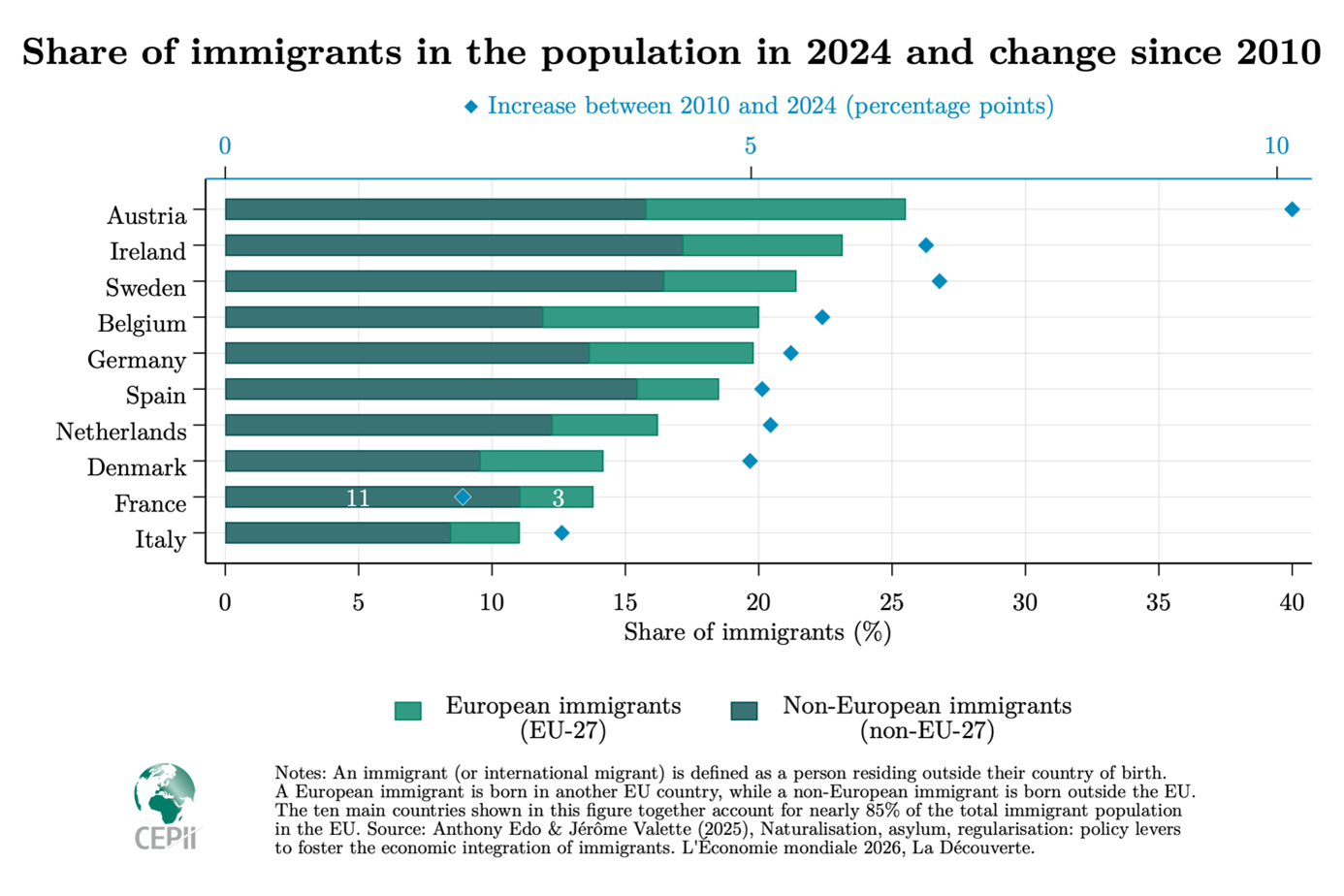 The share of immigrants in the population of the European Union increased between 2010 and 2024, but at very different rates across countries. Anthony Edo, Jérôme Valette >>> |
| International Economics: December 2025 issue is available online  International Economics is a peer-reviewed journal devoted to the publication of research in the area of applied international economics. The journal especially welcomes empirical contributions that include, but are not limited to, topics in international trade, commercial policy, open economy macroeconomics, international finance, exchange rates, financial and monetary policies, economic development, migration and factor movements. The December 2025 issue is available online, and the March 2026 issue is in progress but contain articles that are final and fully citable. >>> |
To Stay Informed

- Contact us
- Our other sites
 |
 |
 |
ISSN: 1255-7072
Editorial Director : Antoine BouëtManaging Editor : Evgenia Korotkova